PME means professional military education. The Classroom version is also available for high school.
A student asks an AI for feedback on a draft paper, then a better structure, then a more strategic version, and revises after each. The Irreducible Officer calls what can happen next invisible delegation: a request for help transfers criteria, structure or meaning, and the student doesn't notice. The task, the rubric, the requests and both students are a constructed example.
PME (professional military education): the original example from The Irreducible Officer, the National War College essay.
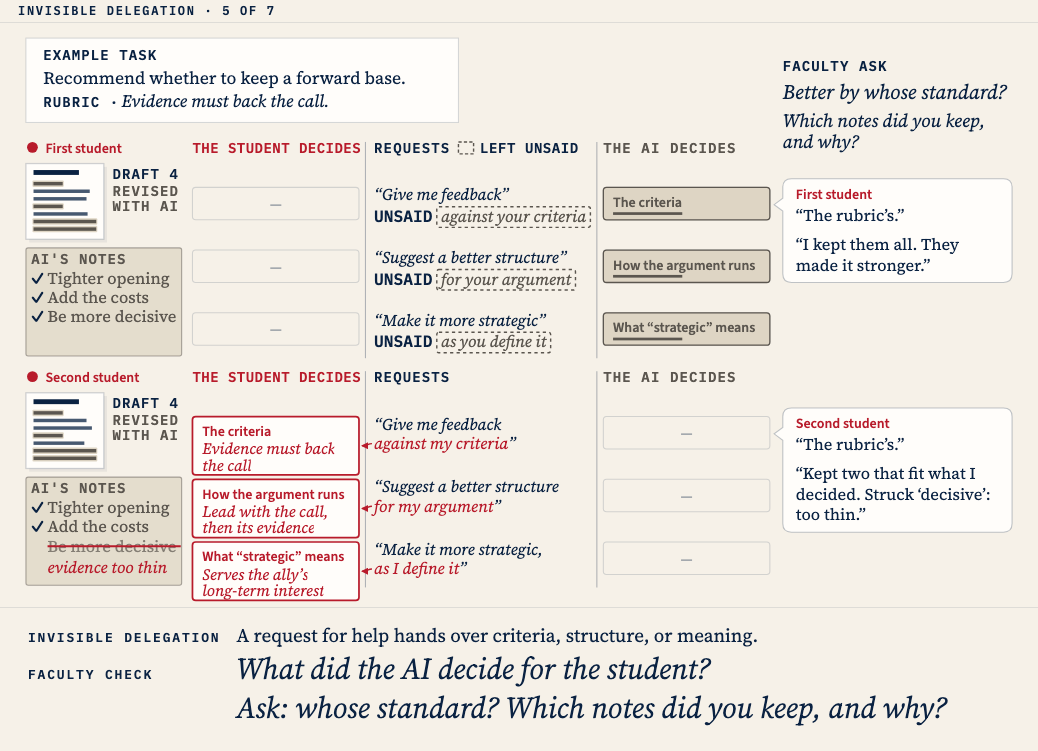
An animated figure. A red dot stands for a student improving a draft strategy paper, for an example task: recommend whether to keep a forward base. The task card carries a rubric: evidence must back the call. Beside the paper is a ledger in three lanes: "The student decides", "Requests" and "The AI decides". Three undecided cards start in the student's lane: the criteria, how the argument runs, and what "strategic" means. The student asks an AI, "Give me feedback." The request carries the criteria card across into the AI's lane, where it turns grey. The AI's notes come back ("Tighter opening", "Add the costs", "Be more decisive"), and the student ticks all three and revises. The student then asks, "Suggest a better structure," and "Make it more strategic." Each request carries a card across, and the student revises to draft 4. Then, under each request, a line marked "unsaid" shows what it left out, in a dashed box: against your criteria, for your argument, as you define it. A second student, with the same task, starts from the rubric, which is enlarged and highlighted. Before each request, they write the decision on its card in red: "Evidence must back the call"; "Lead with the call, then its evidence"; "Serves the ally's long-term interest". Then they ask: "Give me feedback against my criteria," "Suggest a better structure for my argument," "Make it more strategic, as I define it." Their cards stay in their lane. Both get the same AI notes. The second student judges them against their decisions: they tick two and strike "Be more decisive", writing "evidence too thin". Their paper gets the same grey help. Faculty ask each student, with only the two papers to go on, both marked "Revised with AI": "Better by whose standard?" Both say, "The rubric's." Then they ask, "Which notes did you keep, and why?" The first says, "I kept them all. They made it stronger." The second says, "Kept two that fit what I decided. Struck 'decisive': too thin." The figure ends on the faculty check. Each beat is listed below with what is on screen.
0Invisible delegation · Failure mode 5 of 7
On screen: the name, "Invisible delegation", appears large over the stage with "Failure mode 5 of 7" above it, then moves into the top-left corner, where it stays.
1A student wants to improve a draft paper. We'll track three decisions it needs.
On screen: a task card at the top left: "Example task. Recommend whether to keep a forward base. Rubric: evidence must back the call." A red dot labelled First student appears with a draft paper. Beside it, a ledger in three lanes: "The student decides", "Requests" and "The AI decides". Three dashed cards, still undecided, sit in the student's lane: "The criteria", "How the argument runs" and "What 'strategic' means". The AI's lane shows three empty slots.
2The student asks an AI for feedback. The request carries the criteria across.
On screen: a speech bubble, "Give me feedback", clips onto the criteria card, and the two travel slowly across into the AI's lane, where the card turns grey. The request settles in the middle lane. The AI's notes appear under the paper: "Tighter opening", "Add the costs", "Be more decisive". The student ticks all three: draft 2, revised with AI.
3Then for a better structure, and a more strategic version.
On screen: "Suggest a better structure" carries "How the argument runs" across, and "Make it more strategic" carries "What 'strategic' means". Both turn grey in the AI's lane. The AI's grey headings and paragraph appear in the paper, and the student revises to draft 4.
4Each request left out whose standard to use. The AI used its own.
On screen: a key appears, "Left unsaid". Under each request, a line marked "unsaid" with the words in a dashed box: against your criteria; for your argument; as you define it. The three grey cards pulse.
5A second student starts from the same task and rubric.
On screen: the first student's ledger moves up, and a second student appears below with a draft and the same three dashed cards. Their dot goes up to the task card, and the rubric line, "Evidence must back the call", grows larger and is highlighted.
6Before each request, the second student writes the decision down.
On screen: the dot writes on the criteria card, which turns red: "Evidence must back the call." Then it asks, "Give me feedback against my criteria," with a red pointer back to the card. It writes "Lead with the call, then its evidence" on "How the argument runs" and asks, "Suggest a better structure for my argument." It writes "Serves the ally's long-term interest" on "What 'strategic' means" and asks, "Make it more strategic, as I define it." All three cards stay red in the student's lane; the AI's lane stays empty.
7Both get the same AI notes. The second student judges them against their decisions.
On screen: the same notes appear under the second paper: "Tighter opening", "Add the costs", "Be more decisive". The student ticks the first two. The criteria card pulses as the student strikes "Be more decisive" in red and writes underneath: "evidence too thin". The same grey headings and paragraph appear in this paper, up to draft 4.
8Faculty ask each student two questions, with only the papers to go on.
On screen: the ledgers and notes fade; the two papers stay, both at draft 4 and marked "Revised with AI". "Faculty ask: Better by whose standard?" appears, and both students give the same answer: "The rubric's." A second question appears: "Which notes did you keep, and why?" The first student says, "I kept them all. They made it stronger." The second says, "Kept two that fit what I decided. Struck 'decisive': too thin."
9Faculty check: What did the AI decide for the student? Ask: whose standard? Which notes did you keep, and why?
On screen: both lines appear under the picture at the same size, and the ledgers and notes return: the first student's three decisions in the AI's lane, the second student's three in their own, in their words.
Faculty check
What did the AI decide for the student?
Ask: whose standard? Which notes did you keep, and why?
A student who didn't notice what they handed over can honestly answer the check's first line with "nothing", and both students name the rubric when asked whose standard it was. The follow-up separates them. In the figure, both students have the same rubric and get the same AI notes. The first keeps every note because each made the paper stronger: the AI's reason. The second wrote their decisions down first, the criteria from the rubric, and gives their own reasons: two notes fit those decisions, and "Be more decisive" doesn't, because the evidence is too thin. A student who decided first could keep every note and still say why each fits. The essay's own pairs give the follow-ups: feedback against which criteria, a better structure for which argument, more strategic in what sense. The companion's failure-mode lab adds a fair objection: an assistant can legitimately propose criteria. The trouble starts when a student accepts them without seeing how they relate to the task.
From the essay
Invisible delegation occurs when the student does not notice which parts of the work they have handed over. Asking for "feedback" may delegate criteria. Asking for "a better structure" may delegate the argument. Asking for "counterarguments" may delegate the range of imaginable objections. Asking for "a more strategic version" may delegate the meaning of strategic. The language of assistance hides the transfer of judgment. The student believes they are working; the model has already done the framing.
Minimal-context prompting inherits the model's frame almost entirely. Structured prompting with explicit purpose and evaluation criteria moves the human contribution upstream.