PME means professional military education. The Classroom version is also available for high school.
A student asks an AI for help with a strategy paper, and the AI proposes a reasonable way to frame the problem. The student works hard from there. The Irreducible Officer calls what can happen next frame capture: the first plausible frame becomes the student's frame. The task and the six considerations are a constructed example.
PME (professional military education): the original example from The Irreducible Officer, the National War College essay.
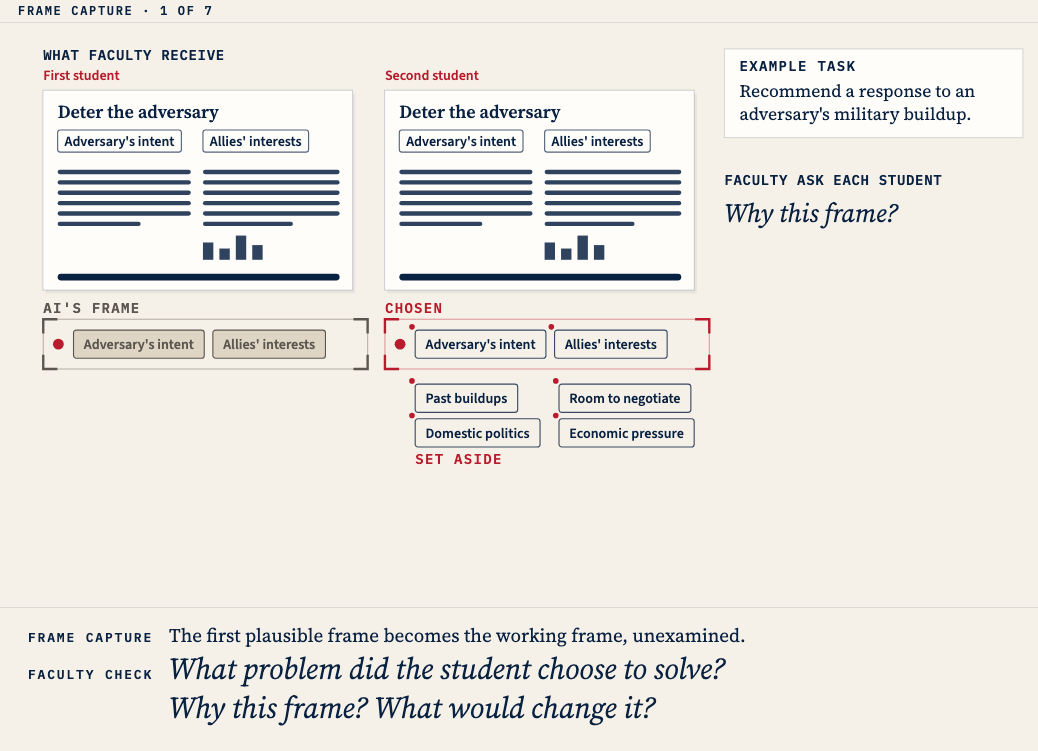
An animated figure. On the left, a red dot stands for a student, surrounded by six dashed considerations. An AI's grey frame takes in two of them and turns the task, "recommend a response to an adversary's military buildup", into "deter the adversary". The student steps into the frame and writes and revises a paper there. The view moves to the faculty side, where the paper arrives and the signs of the AI's frame drain out of it. A second student, also working with AI, gets the same proposed frame, weighs all six considerations, chooses that frame and writes an identical paper. Asked why this frame, the first student can show only the AI's two considerations; the second can show all six and the choice. The figure ends on the faculty check. Each beat is listed below with what is on screen.
0Frame capture · Failure mode 1 of 7
On screen: the name, "Frame capture", appears large over the stage with "Failure mode 1 of 7" above it, then moves into the top-left corner, where it stays.
1A student gets an open strategy task.
On screen: a task card appears at the top right: "Example task: Recommend a response to an adversary's military buildup." A red dot labelled Student appears on the left.
2Many things could matter. Framing means picking which ones define the problem.
On screen: six considerations appear one at a time in dashed outline, three above an open space and three below: past buildups, allies' interests, adversary's intent, domestic politics, room to negotiate, and economic pressure.
3The student asks an AI. It narrows the task to deterrence: reasonable, but narrower.
On screen: the dot pulses. Grey corner brackets labelled "AI's frame" snap around the open space beside the student. A grey copy of the task sentence appears in the frame; every word fades except "adversary", and "Deter the" appears in front of it. Adversary's intent and allies' interests slide inside as grey headings.
4The student takes up the frame. Up close, it's all they see.
On screen: the dot steps into the frame. The view moves in until the frame fills it, and the dot writes a rough first draft in two columns under the AI's headings.
5The student revises twice, adding evidence and a firmer conclusion.
On screen: the dot straightens the rows, then adds a chart and a conclusion across both columns. Red change bars mark each revision. The red label reads Student's draft 3.
6Step back with us: every revision stayed inside the AI's frame.
On screen: the view pulls back to the whole picture while the dot stays where it is. The four dashed considerations sit where they were. Every red mark is inside the grey brackets.
7Faculty receive the final copy. Nothing in it shows the frame came from the AI.
On screen: a clean final copy of the paper travels to the faculty side and stops in the middle, large, labelled "What faculty receive: the final copy". It is still inside grey brackets, and a key marks its tinted title and headings as "AI-supplied". A wipe crosses it, and the title and headings turn the same ink as the rest, keeping their words. The brackets and the key fade, and the paper moves to the top left, labelled "From this student".
8A second student, also working with AI, weighs all six and chooses this frame.
On screen: the label over the first paper becomes "First student". A second red dot labelled Second student appears. Its AI proposes the same frame: grey brackets tagged "AI's frame" around adversary's intent and allies' interests, with the other four outside. The dot touches each of the six in turn, and each turns solid. Then the brackets turn red and the tag reads "Chosen"; the other four go under "Set aside".
9That student writes the same paper; the weighing doesn't show.
On screen: the second dot writes a paper identical to the first, labelled "Second student". Then the weighing slides up behind the paper and is hidden.
10Ask each student why this frame. One can show what they weighed.
On screen: "Faculty ask each student: Why this frame?" appears. From behind each paper, what it rests on slides into view. Under the first is only the AI's grey frame around its two considerations, with the first student inside. Under the second is the same frame in red, chosen, with the four set aside below.
11Faculty check: What problem did the student choose to solve? Why this frame? What would change it?
On screen: the questions appear under the picture, at the same size. The task card's "a response" and the papers' title, "Deter the adversary", are both in view.
Faculty check
What problem did the student choose to solve?
Why this frame? What would change it?
Both students in the figure would answer the first question the same way. The second line separates them. It comes from Section VIII of the essay, which asks: why this problem, why this frame, what would change it?
From the essay
Frame capture occurs when the model supplies the first plausible frame and the student never achieves enough distance to revise it. The danger is not that the frame is obviously wrong; it may be entirely reasonable. It may simply define the problem too narrowly, privilege one set of interests over others, assume a theory of adversary behavior, or treat a structural constraint as fixed when it should be contested. Once accepted, later revisions improve the answer inside the wrong boundary. The frame capture is invisible inside the final product.