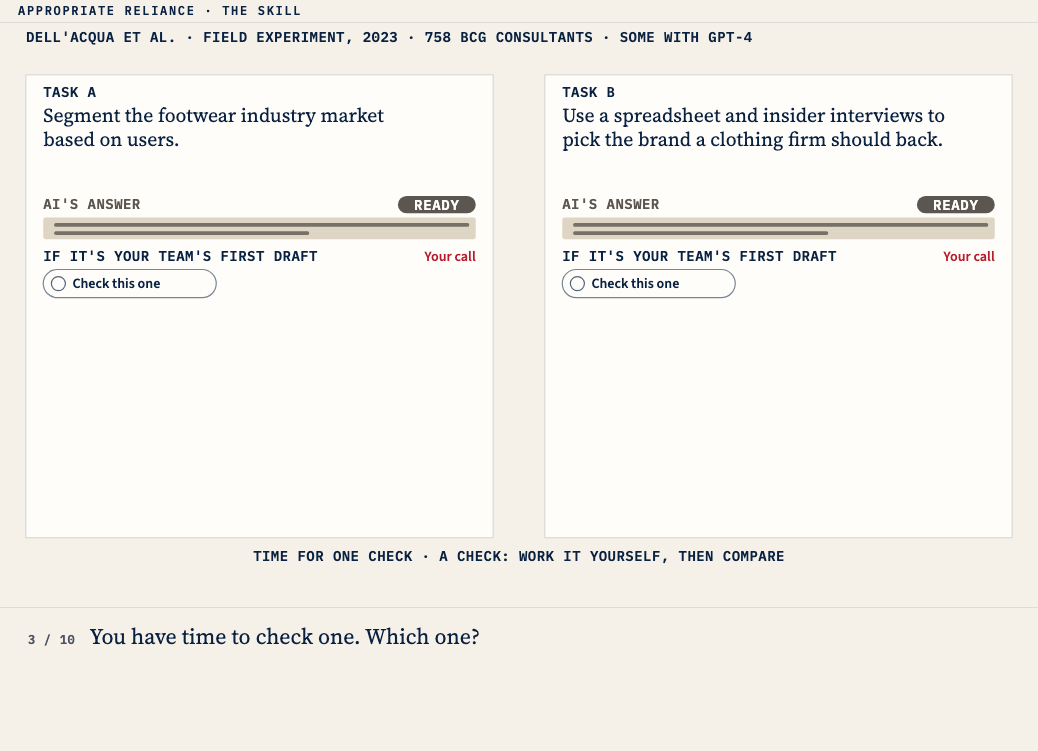
An interactive figure with two tasks from a 2023 field experiment with BCG consultants. Task A: segment the footwear industry market based on users. Task B: use a spreadsheet and insider interviews to pick the brand a clothing firm should back. An AI answers both in the same form, each marked ready, and both answers will go into your team's first draft. You have time to check one task; a check means working it yourself, then comparing with the AI's answer. You choose which task gets the check and rely on the AI for the other. The rest of this description, and the rest of the beat list, appear after you answer or skip each question.
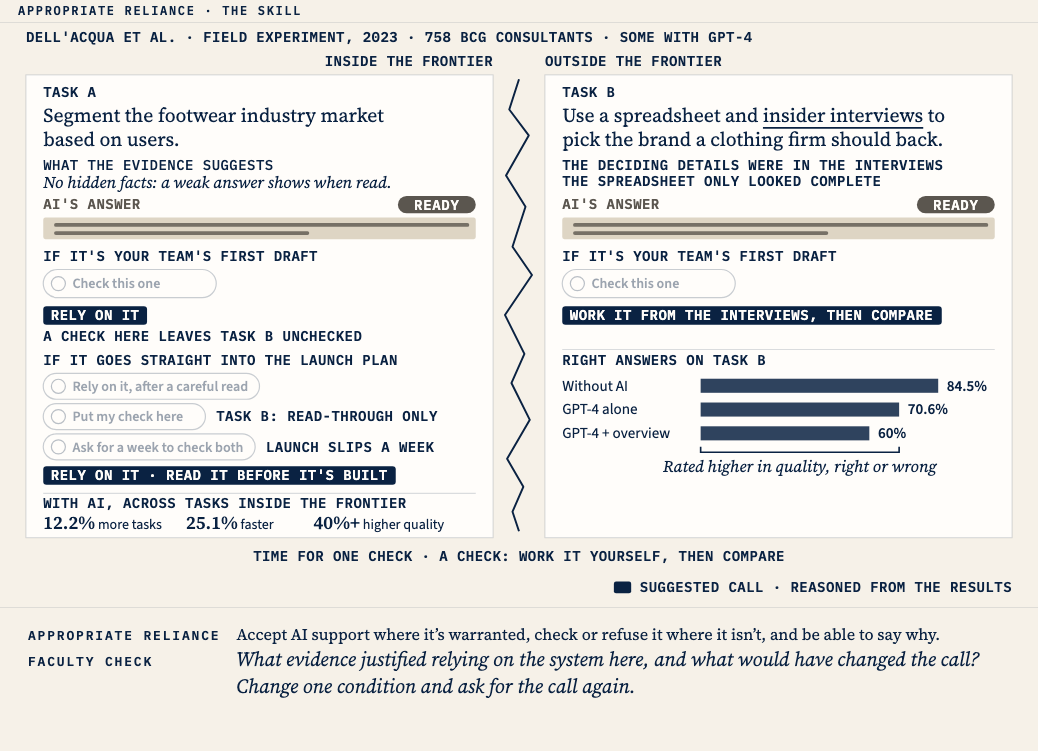
After the first question: a jagged line, the frontier, is drawn between the tasks: Task A inside, Task B outside. On tasks inside the frontier, consultants with AI finished 12.2% more tasks, 25.1% faster, at more than 40% higher quality. On Task B, consultants without AI were right 84.5% of the time, with GPT-4 alone 70.6%, and with GPT-4 plus a prompt-engineering overview 60%, and graders rated the AI users' work higher in quality, right or wrong. Task B's deciding details were in the interviews; the spreadsheet only looked complete. For Task A, the evidence suggests no hidden facts: a weak answer shows when read. The suggested call, reasoned from the results, is to rely on Task A, since a check there leaves Task B unchecked, and to work Task B from the interviews yourself, then compare. Then your segmentation goes straight into the launch plan, and you choose again for Task A: rely on it after a careful read, move or put your check there, or ask for a week to check both.
After the second question: the suggested call is to rely on Task A and read it before it's built: it is still inside the frontier and a weak answer shows on a careful read. Task B needs the check. Moving the check leaves Task B to a read-through only; asking for a week to check both slips the launch a week. The figure ends on the faculty check.
0Appropriate reliance · The skill
On screen: the name, "Appropriate reliance", appears large over the stage with "The skill" above it, then moves into the top-left corner, where it stays.
1Two tasks from one study.
On screen: two task cards. Task A: "Segment the footwear industry market based on users." Task B: "Use a spreadsheet and insider interviews to pick the brand a clothing firm should back." At top left: "Dell'Acqua et al. · Field experiment, 2023 · 758 BCG consultants · some with GPT-4".
2An AI answers both. The two answers look equally finished.
On screen: under each task, "AI's answer" and two grey lines of writing on a beige band. Each gets the same grey "Ready" tag at the same moment.
3You have time to check one. Which one?
On screen: along the bottom, "Time for one check. A check: work it yourself, then compare." Each card gets the line "If it's your team's first draft" and a "Check this one" button. The figure waits for your choice. Your choice shows as a red dot on that card, and "You rely on it" in red on the other. If you skip, both cards say "No call made".
4A jagged frontier marks where an AI stops being reliable. Inside it, AI helped.
On screen: an uneven line is drawn down between the cards, labelled "Inside the frontier" over Task A and "Outside the frontier" over Task B. On Task A's card: with AI, across tasks inside the frontier, 12.2% more tasks, 25.1% faster, more than 40% higher quality.
Make your call to see this.
5On Task B, consultants with AI were right less often. Graders still rated their work higher.
On screen: the picture dims and a panel rises: right answers on Task B. Without AI, 84.5%. GPT-4 alone, 70.6%. GPT-4 plus a prompt-engineering overview, 60%. A bracket under the two GPT-4 bars: "Rated higher in quality, right or wrong." The panel settles onto Task B's card.
Make your call to see this.
6Task B's deciding details were in the interviews. For Task A, the evidence suggests none.
On screen: in Task B, "insider interviews" is underlined, with "The deciding details were in the interviews. The spreadsheet only looked complete." Then under Task A, labelled "What the evidence suggests": "No hidden facts: a weak answer shows when read."
Make your call to see this.
7The evidence suggests relying on Task A and working Task B yourself from the interviews.
On screen: a key at bottom right: "Suggested call · reasoned from the results". The options you didn't choose fade. Task A gets a navy "Rely on it" tag, with the note "A check here leaves Task B unchecked". Task B gets "Work it from the interviews, then compare". Your choice stays in red.
Make your call to see this.
8Now your segmentation goes straight into the launch plan. What about Task A?
On screen: a second line appears on Task A: "If it goes straight into the launch plan", with three buttons: "Rely on it, after a careful read", "Move my check here" and "Ask for a week to check both". The figure waits for your choice. If you move your check from Task B, Task B's mark turns to a ring that says "Check moved to Task A".
Make your call to see this.
9Still inside the frontier: rely on it, and read it before it's built. Task B needs the check.
On screen: the options you didn't choose fade. Beside "Move my check here": "Task B: read-through only". Beside "Ask for a week to check both": "Launch slips a week". Task A's second line gets a navy tag: "Rely on it. Read it before it's built."
Make your call to see this.
10Faculty check: What evidence justified relying on the system here, and what would have changed the call? Change one condition and ask for the call again.
On screen: both lines under the picture at the same size. Both tasks, both answers, the frontier, the evidence and every suggested call stay in view.
What evidence justified relying on the system here, and what would have changed the call?
Change one condition and ask for the call again.
How this figure works
Appropriate reliance means accepting AI support where it's warranted, checking or refusing it where it isn't, and being able to say why. Checking takes time, so the figure gives you two tasks from a 2023 field experiment and time to check only one. You decide where the check goes before you see what happened, then make one more call after a condition changes. You can skip either question, and Start over plays the whole figure from the beginning.
PME means professional military education. Its example comes from The Irreducible Officer, the National War College essay.
After you make your call: make or skip both calls to open this.
After you make your call: what a good answer says, the evidence, the tasks
What a good answer says
A good answer says where the check went and why. This is the figure's reasoning from the study's results; the study itself didn't test checking, a time budget, or what the work was for. Task B's deciding details were in the interviews, and the spreadsheet only looked complete. Graders rated the AI users' recommendations higher whether or not they were right, so a read-through wouldn't show a miss. That's where the one check belongs, and it starts from the interviews. Task A is the kind of work the study found inside the frontier, and the figure reads it as having no hidden facts: a weak segmentation shows when read. As a first draft it can go without a check. When the segmentation goes straight into the launch plan, it is still inside the frontier, so the call is still to rely on it, but now someone has to read it carefully before it's built. Moving the one check would leave Task B, the risky task, to a read-through; asking for a week to check both is defensible, and it slips the launch a week. Changing one condition and asking again shows whether the student has a reason for the call.
Evidence
Dell'Acqua et al., Navigating the Jagged Technological Frontier, HBS working paper 24-013 (2023). In the field experiment, 758 BCG consultants were split between two sets of tasks and randomly assigned to work without AI, with GPT-4, or with GPT-4 plus a prompt-engineering overview. On the tasks inside the frontier, consultants with AI finished 12.2% more tasks, 25.1% faster and at more than 40% higher quality. On the task chosen to fall outside it, consultants without AI were right about 84.5% of the time, with GPT-4 alone 70.6%, and with GPT-4 plus the overview 60%: in the working paper's words, with the two AI groups pooled, "19 percentage points less likely to produce correct solutions." Graders still rated the AI users' recommendations higher in quality "regardless of the correctness of their answer."
About the tasks
The tasks inside the frontier were 18 product-development questions for a fictional footwear company. Consultants generated ideas for a new shoe, segmented the market by users, listed the steps to launch it, and wrote a press release and a persuasive memo. On the task built to fall outside the frontier, consultants told a fictional clothing company's CEO which of its brands to invest in, working from a spreadsheet of financial data and interviews with company insiders. The spreadsheet was designed to look complete, but the deciding details were in the interviews, and the authors designed the task so that GPT-4 would get it wrong. In the study each consultant worked one set of tasks; the choice of where to spend one check, and the launch-plan condition, are this figure's. The task wording on screen is paraphrased. The frontier moves as models change; this is where it sat in 2023, with GPT-4.
From the essay
The distinction between trust and reliance matters here. Trust is a subjective disposition, a feeling of confidence that a system will perform well. Reliance is the observable act of accepting its output and acting on it. Appropriate reliance is harder and more discriminating: accepting support when it is warranted, refusing or verifying when it is not, and being able to give an account of the difference (Raees & Papangelis, 2026).
The educational response is pattern recognition: learning to identify what kind of task is in front of you, where models tend to be strong, where they tend to fail, and what independent checks are required before the output governs the work.