PME means professional military education. The Classroom version is also available for high school.
A student reads six readings closely, then asks an AI to connect them for a seminar paper. The map is sound, and the student writes a good paper from it. The Irreducible Officer calls the risk premature synthesis: the model connects material before the student has built the map. The task and answers are a constructed example.
PME (professional military education): the original example from The Irreducible Officer, the National War College essay.
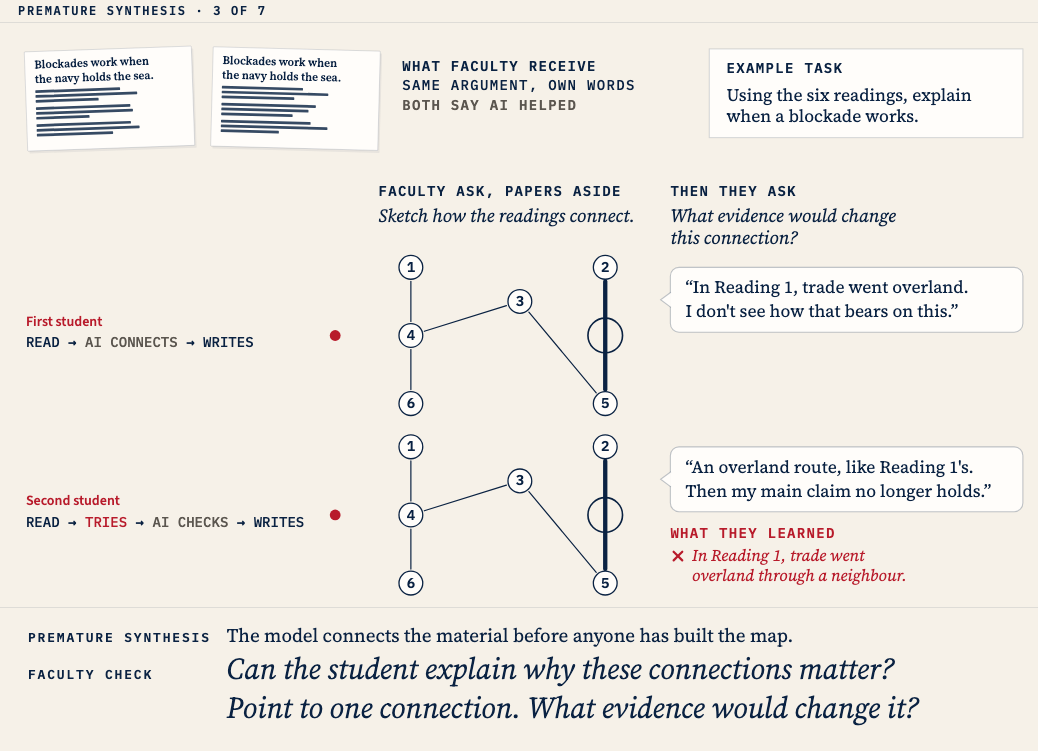
An animated figure. A red dot stands for a student with an example task: using six readings, explain when a blockade works. Six reading cards sit unconnected: a northern blockade, an island blockade, trade routes, allies split, a long blockade and coercion theory. The student reads each card closely, then asks an AI to connect them, and the AI draws five grey connections at once. The student follows each one and writes a paper titled "Blockades work when the navy holds the sea", whose main claim rests on the connection between readings 2 and 5, with a note that AI helped connect the readings. A second student reads each card just as closely, then draws four connections of their own. They try a fifth, between readings 1 and 2, check both readings and drop it, noting: "In Reading 1, trade went overland through a neighbour." That student then asks an AI, which draws the same five connections. Four match, and the student checks the fifth, between readings 3 and 4, before keeping it. The second student writes their own paper with the same argument. Faculty put both papers aside and ask each student to sketch how the readings connect; both sketch the same map. The first student's row reads "read, AI connects, writes"; the second's reads "read, tries, AI checks, writes". Faculty point to the connection between readings 2 and 5 and ask what evidence would change it. The first student says, "In Reading 1, trade went overland. I don't see how that bears on this." The second student, remembering what they learned, says, "An overland route, like Reading 1's. Then my main claim no longer holds." The figure ends on the faculty check. Each beat is listed below with what is on screen.
0Premature synthesis · Failure mode 3 of 7
On screen: the name, "Premature synthesis", appears large over the stage with "Failure mode 3 of 7" above it, then moves into the top-left corner, where it stays.
1A student must connect six readings in a seminar paper.
On screen: a task card appears at the top right: "Example task: Using the six readings, explain when a blockade works." A red dot labelled Student appears on the left. Six numbered reading cards appear one at a time: 1 Northern blockade, 2 Island blockade, 3 Trade routes, 4 Allies split, 5 Long blockade, 6 Coercion theory. Nothing joins them yet.
2The student reads all six closely, then asks an AI to connect them.
On screen: the dot visits each card, and each opens to show notes. The dot pulses. Five dashed grey lines appear all at once, labelled "AI's map", joining 1 to 4, 4 to 6, 3 to 4, 3 to 5 and 2 to 5.
3The map makes sense to the student, who writes the paper from it.
On screen: the dot follows each grey line, and each turns solid. The dot writes a paper on the left, labelled "First student's paper" and titled "Blockades work when the navy holds the sea." As the title appears, the line from 2 to 5 turns heavy. The first paragraph, tagged "Main", cites readings 2 and 5; the others cite 3, 4 and 5, and 1, 4 and 6. A grey note at the foot says "AI helped connect the readings".
4A second student reads them just as closely, then tries connections first. One doesn't hold.
On screen: the grey lines and the first dot leave, and the cards close. A second red dot labelled Second student visits each card the same way, and each opens to show notes. The dot draws four red lines: 2 to 5, 3 to 5, 1 to 4 and 4 to 6. It draws a fifth, from 1 to 2, and goes back to both cards. A red cross appears on that line, with a red note: "In Reading 1, trade went overland through a neighbour." The line pulls back; the cross and the note stay.
5That student then asks an AI too and checks its map against their own.
On screen: the dot pulses. The AI's map appears in grey dashes, the same five lines it drew for the first student. Four lie on the red lines and merge into them. The cross brightens: no line appears there. The fifth line, 3 to 4, is new: the dot checks cards 3 and 4, and the line turns red.
6That student writes their own paper. Both make the same argument.
On screen: the dot writes a second paper under the first, labelled "Second student's paper", with the same title, citations and grey note, and lines of different lengths. The cards, lines and note leave. "What faculty receive. Same argument, own words." appears above the two papers.
7Without the papers, both students sketch the same connections.
On screen: the papers shrink and slide up into a strip at the top left, next to "Both say AI helped". "Faculty ask, papers aside: Sketch how the readings connect." appears. Each row is labelled: "First student: read, AI connects, writes" and "Second student: read, tries, AI checks, writes". Each student draws six numbered points joined by the same five lines, in the same ink.
8Faculty ask about the main connection. The first student recalls Reading 1 but can't apply it.
On screen: "Then they ask: What evidence would change this connection?" appears, and on both sketches the line from 2 to 5 is ringed. The first student says: "In Reading 1, trade went overland. I don't see how that bears on this."
9The second student applies it, from the connection that didn't hold.
On screen: in the second student's row, "What they learned" appears in red over the note: "In Reading 1, trade went overland through a neighbour." The second student says: "An overland route, like Reading 1's. Then my main claim no longer holds."
10Faculty check: Can the student explain why these connections matter? Point to one connection. What evidence would change it?
On screen: the questions appear under the picture at the same size. The set-aside papers, the row labels, the sketches, both answers and the note stay in view.
Faculty check
Can the student explain why these connections matter?
Point to one connection. What evidence would change it?
Both students in the figure can sketch the map, and both know the fact that matters. The second line separates them. The student who worked out the connections can say what evidence would change one and what depends on it. In the essay's oral defense (Section IX), faculty ask what evidence would change the recommendation.
From the essay
Premature synthesis appears when a student asks AI to connect material before doing enough work to know what should be connected. The output links sources, themes, and concepts in ways that feel coherent. But if the student cannot reconstruct why those connections matter, the synthesis belongs to the model. The student has bypassed the developmental struggle of forming a mental map and inherited one instead.
These are developmental events. If AI removes them too early, supplying the first frame before the student has struggled to form one or synthesizing sources before the student has built the mental map to evaluate those connections, it produces a more polished artifact and a weaker thinker.