PME means professional military education. The Classroom version is also available for high school.
Ten analysts at an industrial-equipment maker each use the company's AI to help answer the CEO's question: how should we respond to a low-cost competitor? Each writes their own plan, and each plan holds up when read alone. What can still go wrong is institutional monoculture: shared systems and defaults narrow the range of frames a group considers. It can happen wherever people ask the same AI, like a nonprofit's program team asking how to respond to a funder's new priority. Illustration based on Romasanta, Thomas & Levina (2026) and Bottesch (2025). The team, the question and the plans are constructed.
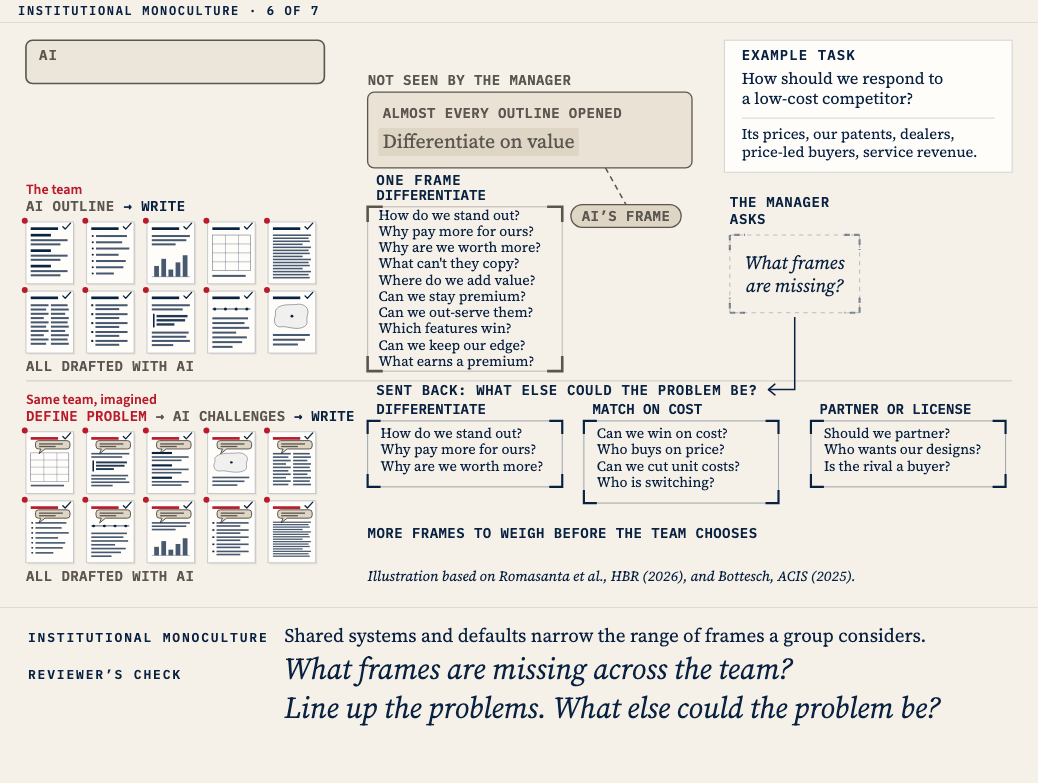
An animated figure that opens on its name, Institutional monoculture, failure mode 6 of 7. Ten red dots stand for ten analysts at an industrial-equipment maker with an example task, the CEO's question: how should we respond to a low-cost competitor? The context lists its prices, our patents, dealers, price-led buyers and service revenue. Each analyst asks the company's AI for an outline, and ten grey outlines come back in the same pattern. Each analyst writes their own plan, in ten different layouts, all marked "All drafted with AI". The manager sees that each plan holds up, and the ticks stay. The manager lines up the one-line problem statement from every finished plan: "How do we stand out?", "Why pay more for ours?", "Why are we worth more?", "What can't they copy?", "Where do we add value?", "Can we stay premium?", "Can we out-serve them?", "Which features win?", "Can we keep our edge?", "What earns a premium?". Each line is read, and a bracket closes around all ten, labelled "One frame: differentiate". The manager sees only the finished plans, but the figure shows the viewer where the frame came from: a grey card comes out of the AI box, saying almost every outline opened with "Differentiate on value", labelled "Not seen by the manager". A dashed grey line runs from it to the bracket, which turns grey, with a grey tag: "AI's frame". The manager asks what frames are missing: a dashed box with that question appears beside the bracket. Next, while the first run dims above, the figure imagines the manager sending the plans back: a navy line runs from the question box to the heading "Sent back: what else could the problem be?", over the same team, imagined. Each analyst writes the problem in red first, then asks the AI to challenge it ("What did you assume? What other frames fit?"), and a grey speech bubble appears on each plan before they write. These plans hold up too. Their problems are lined up under the heading in three groups, with a line under them: more frames to weigh before the team chooses. The groups: differentiate ("How do we stand out?", "Why pay more for ours?", "Why are we worth more?"); match on cost ("Can we win on cost?", "Who buys on price?", "Can we cut unit costs?", "Who is switching?"); partner or license ("Should we partner?", "Who wants our designs?", "Is the rival a buyer?"). The figure ends on the reviewer’s check, with the source under the picture. Each beat is listed below with what is on screen.
0Institutional monoculture · Failure mode 6 of 7
On screen: the name, "Institutional monoculture", appears large over the stage with "Failure mode 6 of 7" above it, then moves into the top-left corner, where it stays.
1Ten analysts get the CEO's question.
On screen: a task card appears at the top right: "Example task. How should we respond to a low-cost competitor?" Ten blank plans appear in two rows of five, each with a red dot, labelled "The team". Under a line on the card, the context appears one item at a time: its prices, our patents, dealers, price-led buyers, service revenue.
2Each asks the company's AI for an outline. They come back alike.
On screen: a grey box marked AI appears at the top left. A small mark travels from each red dot up to it, and ten grey outlines drop back into the plans, all in the same pattern.
3Each writes their own plan. The manager sees that each holds up.
On screen: each dot writes over its outline, and each plan turns to ink in its own layout: headings, bullets, a chart, a table, dense text, two columns, a numbered list, a pull quote, a timeline, a map. "AI outline, write" and "All drafted with AI" appear. A navy ring steps across the plans and leaves a tick on each.
4The manager lines up each plan's problem.
On screen: each plan's first line is outlined, then lifts out and joins a list at the right: "How do we stand out?", "Why pay more for ours?", "Why are we worth more?", "What can't they copy?", "Where do we add value?", "Can we stay premium?", "Can we out-serve them?", "Which features win?", "Can we keep our edge?", "What earns a premium?". The plans stay where they are, ticked.
5Different words, one frame: each plan differentiates.
On screen: a navy reading mark appears beside each line in turn. Then a bracket closes around all ten, labelled "One frame: differentiate".
6The manager doesn’t see this: almost every AI outline opened with that frame.
On screen: a grey card comes out of the AI box: "Almost every outline opened: Differentiate on value". A grey label above the card reads "Not seen by the manager". A grey line runs from it to the bracket, which turns grey, and settles dashed; a grey tag beside the bracket reads "AI's frame". The manager sees only the finished plans; the card and the grey are for the viewer.
7The manager asks what frames are missing.
On screen: beside the bracket, in open space, a dashed box appears, labelled "The manager asks", with the question inside: "What frames are missing?"
8Imagine the manager sends them back: what else could the problem be?
On screen: the first run moves to the upper half and dims, with the grey card above its list and the question box beside it. A navy line runs from the question box down to a heading: "Sent back: what else could the problem be?". Below a line, "Same team, imagined" appears with ten blank plans. Each dot writes a red first line, and its label begins "Define problem".
9Each defines the problem first, then asks the AI to challenge it.
On screen: a copy of each red line goes up to the AI box. A grey speech bubble appears: "What did you assume? What other frames fit?", and small grey speech bubbles appear on each plan under its red line. Each dot writes its plan. The label now reads "Define problem, AI challenges, write", and the plans are marked "All drafted with AI".
10These hold up too. The manager lines them up again.
On screen: the speech bubble fades, the first run returns to full strength, and a navy ring ticks each imagined plan. Group by group, their problem lines lift out as words into three labelled columns under the heading: differentiate ("How do we stand out?", "Why pay more for ours?", "Why are we worth more?"); match on cost ("Can we win on cost?", "Who buys on price?", "Can we cut unit costs?", "Who is switching?"); partner or license ("Should we partner?", "Who wants our designs?", "Is the rival a buyer?"). Brackets close around them, and a line under them reads "More frames to weigh before the team chooses".
11Reviewer’s check: What frames are missing across the team? Line up the problems. What else could the problem be?
On screen: the questions appear under the picture at the same size, and the manager's question box pulses once. A source line appears under the picture: "Illustration based on Romasanta et al., HBR (2026), and Bottesch, ACIS (2025)."
Reviewer’s check
What frames are missing across the team?
Line up the problems. What else could the problem be?
Read one at a time, every plan holds up. The plans differ in their details, like names, numbers and products, but lined up, they share one problem definition, the one almost every AI outline opened with. The manager never sees those outlines; the lineup of finished plans is enough to show the shared frame. Lining up shows which frames a team has. It can't show which are missing. For that, the manager asks what else the problem could be, drawing on their own knowledge of the market or on frames the team names before discussion settles on one. In the imagined rerun the manager sends the plans back with that question. Each analyst then writes a problem frame without AI and asks an AI to find assumptions they missed and suggest other frames, as the original essay, The Irreducible Officer, proposes. Whether framing first spreads frames across a team is untested, and the imagined rerun is one possible answer. Agreement can also come from a shared purpose or strong evidence, and a different frame isn't better by itself. A team can compare several frames and still agree on one.
About the example. Each plan's first line is its problem statement: the question the plan sets out to answer. The figure groups problems by the goal they set, and names three goals for the imagined team as one possible answer. Telling real frames apart takes reading. The plans, their problem lines and the AI's opening line are constructed. They don't show the output of any model or the plans of any real company.
The studies behind this example
Romasanta, Thomas and Levina asked leading AI models for strategic advice. Their summary of the work reports: "Across thousands of simulations, we saw LLMs almost uniformly select the same trendy strategies, regardless of context." They name the pattern: "We call the propensity for AI to opt for buzzy ideas over reasoned solutions 'trendslop.'"
That summary names no strategies, and the Harvard Business Review article itself, a practitioner piece, is paywalled. Coverage of the article reports that the models' defaults included differentiation over commoditization, along with augmentation over automation and the long term over the short term. The figure's AI frame, "Differentiate on value", follows that reported default. The plans and their problem lines are constructed.
Bottesch ran a field experiment with "99 knowledge workers from a multinational industrial corporation" and found "that indeed significant homogenisation effects occur in terms of style and content when knowledge workers are supported by GenAI (versus when they are not)". The abstract also offers "initial evidence that these effects might be mitigated through advanced prompting and (more) critical handling of GenAI output by knowledge workers." It is a single-author conference paper from one company, and the abstract gives no effect sizes. The figure draws the plans in different layouts so the shared frame has something to hide behind; Bottesch found that style converged as well.
Neither study lined up a team's plans or tested defining the problem first. The lineup and the imagined team are this figure's illustration of what the findings could mean for a team that drafts with one AI.
Counter-evidence: Terwiesch et al. (Production and Operations Management, 2026) found that better prompting, assigned personas and pooling several vendors brought the diversity of AI-generated ideas close to human levels. With Bottesch's mitigation finding, that suggests sameness is the default, and deliberate design can push against it.
Sources: Romasanta, Thomas & Levina, "Researchers Asked LLMs for Strategic Advice. They Got 'Trendslop' in Return," Harvard Business Review (March 2026), quoted from the authors' summary on NYU Stern's research highlights page; the reported defaults are from coverage of the article. Bottesch, "Towards Generative Monoculture? Insights from a Field Experiment on Style and Content Homogenisation Effects in GenAI-Supported Knowledge Work," ACIS 2025 Proceedings, quoted from the abstract. The team, the question, the plans and the AI's outlines are constructed. The figure shows none of either study's data.
From the original PME essay
Institutional monoculture is the class-level version of the same problem. When many students use similar systems, similar prompts, and similar defaults, the range of strategic frames available to a seminar narrows. AI can create a surface appearance of diversity (different arguments, different structures, different evidence) while reproducing common assumptions at the level of problem definition. Research into the diversity of AI-generated ideas finds that language models aggregate knowledge into a unified distribution in ways that human cognition does not: people exhibit knowledge partitioning, each occupying a distinct semantic region, in ways that independent AI samples do not replicate (Deng, Brucks & Toubia, 2026). Post-training alignment compounds this further, compressing the distribution of outputs toward the statistical center (Murthy, Ullman & Hu, 2024). Pedagogical research on LLM integration in higher education frames this compression as epistemic narrowing: the constraining of students' exposure to diverse, ambiguous, or contested knowledge by tools optimized for convergence and fluency (Vendrell & Johnston, 2026). In a war college seminar, that compression raises a serious possibility: the same systems that help students produce stronger work may also narrow the range of strategic imagination the seminar is meant to develop.