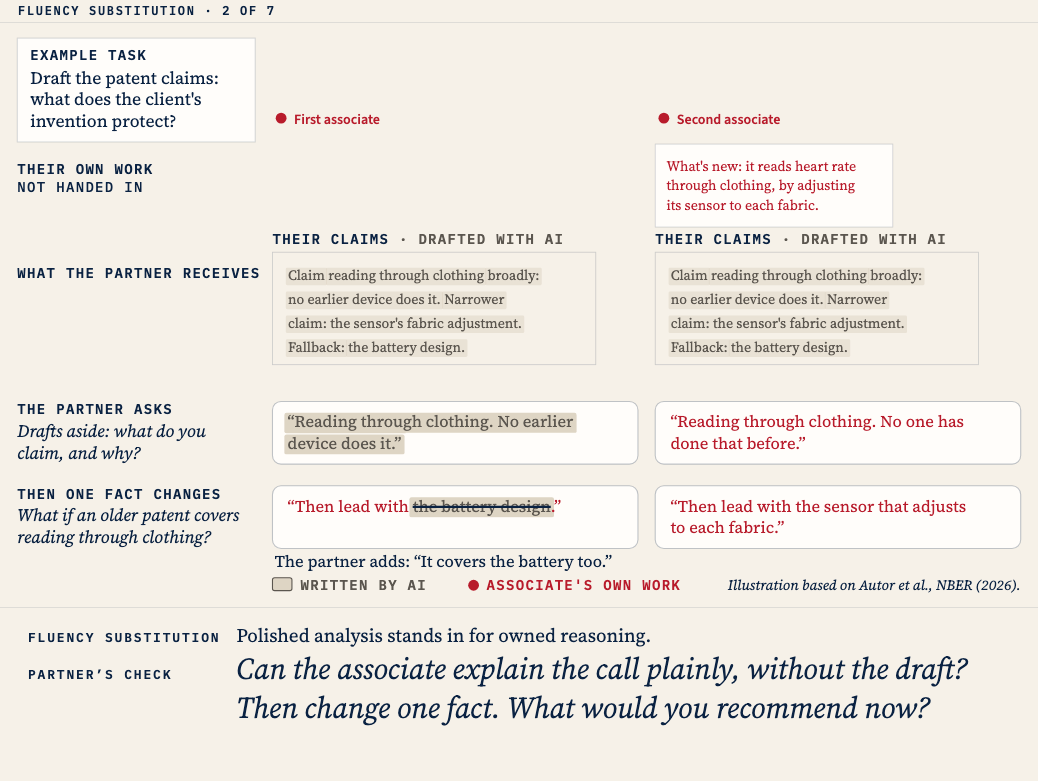
Partner’s check
Can the associate explain the call plainly, without the draft?
Then change one fact. What would you recommend now?
Both associates in the figure explain the claims clearly without the draft. The second line separates them. It comes from The Irreducible Officer, an essay written for military education, which looks for the person who "revises under challenge rather than retreating to the artifact's language".
The study behind this example
In a pre-registered three-month randomized trial, David Autor and colleagues gave "133 practicing patent lawyers at eleven U.S. intellectual property law firms" access to a custom AI patent drafting assistant. Of those, 91 completed the full protocol. Expert raters, blind to who had the tool, scored the work.
The paper's abstract states the finding: "AI access raised the quality of work delivered on benchmark patent drafting tasks at 10 days (0.34 SD, p = 0.03) and 90 days (0.38 SD, p = 0.01), with larger gains among junior lawyers."
At the end, the 91 lawyers who completed the study each reviewed and corrected an existing patent application without AI. "Treated lawyers outperformed controls by 0.32 SD (p = 0.04), but this advantage was concentrated entirely among senior lawyers (0.45 SD, p = 0.02). Junior lawyers showed no average gain. Their scores instead bifurcated, with sharply fewer mediocre scores offset by more poor and more good ones, suggesting that AI assistance served as a springboard for some juniors and a cushion for others."
So the split was among juniors, lawyers with fewer than seven years of experience (p. 23). Seniors gained: "Measured by unassisted judgment, only senior lawyers emerged from three months of AI use with improved capability" (p. 2). Fifteen of the 91 redlines showed possible AI use. Without them, the overall gain falls below conventional significance, while the senior gain holds at the 10 percent level (p. 3).
The authors are plain about the limit: "Our experiment does not answer why the effects appear positive for some lawyers and negative for others" (p. 2). It covers one profession, and the junior group was small. The tool was custom. The study was conducted by Google, Google funded its direct costs, and all eleven firms have patent-drafting relationships with Google.
The figure's two associates show one way the split among juniors could arise. The study's tested results are scores. Its look at reasons, "post-experiment interviews with treated participants and an LLM-based qualitative analysis of redlining submissions" (p. 29), is in supplementary materials "not intended for publication" (p. 9, note 8). The authors float time spent as one possible mechanism: "Juniors using AI worked faster but showed no unassisted gains" (p. 30). The figure's account, writing down what's new before drafting and reworking the call from it when a fact changes, is an illustration; the study didn't test it.
Source: Autor, Rodchenko, Martin, Iscenko, Strand, Pearl & Ferere, "Does AI Assistance Enhance or Erode Expertise? Evidence from a Three-Month Field Experiment in Patent Drafting," NBER Working Paper 35720 (revised October 2026). Quotes are from the abstract unless a page is given. The associates, the invention, the claims, the older patent and the check are constructed.
From the original PME essay
Fluency substitution is easier to miss. AI produces the tone of analytic maturity (balanced paragraphs, caveats in the right places, the measured voice of a considered judgment) and the student mistakes well-ordered language for well-owned reasoning. Researchers studying AI's effects on student cognition have introduced the concept of epistemic confinement to describe this condition: an illusion of competence while operating entirely within AI-constructed analytical boundaries, where the student believes they are thinking independently while the frame doing the work was never theirs (Chow et al., 2026). In strategy, fluency substitutes for deciding. A paragraph that balances every consideration may never identify which risk actually matters most.
The Irreducible Officer, Section II, What the Problem Looks Like
Go further
- The study: Autor et al. (2026), NBER Working Paper 35720
- The original essay, written for military education: The Irreducible Officer, Section II